


In short
Conveyancing lead nurture is a run of emails to people who asked for a quote and haven't instructed yet. Each email should help with that person's matter and area, and the emails should space out or stop as interest fades.
Under PECR, a quote request can count towards the "soft opt-in". That holds only if your firm collected the details itself, the emails are about the same kind of service, and your form and every email offer an opt-out.
This guide is for partners, practice managers and marketing leads at residential conveyancing firms. It draws on the six-month nurture we run for a UK conveyancing firm, described in our conveyancing lead generation case study.
Why follow up a conveyancing quote for six months?
Because many people who ask for a quote aren't ready to instruct on the day they ask. Property chains hold people up, and many are still comparing quotes from several firms. Each useful email is one more chance to be the firm they pick when they are ready.
In the system we run for a UK conveyancing firm, people do come back and instruct later, while the emails are running. That's the case for a long sequence rather than one reminder.
Many firms don't follow up at all. A 2015 mystery shop of 100 firms by TM Group found most of them didn't follow up after a quote call.[1] The data is old, but if your firm still sends one quote and waits, it's the gap to close first.
Who should get nurture emails?
Only people who asked your firm for a quote, haven't instructed, and haven't opted out. That keeps the list small and the emails welcome.
Send nurture emails to
- Someone who filled in your quote form and didn't tick the opt-out.
- Someone who asked your team for a quote and hasn't opted out.
Don't send nurture emails to
- Anyone who instructs. They need matter updates, not sales emails.
- Anyone who unsubscribes, says they've chosen another firm, or whose emails bounce.
- Leads from a lead seller or comparison site. Your firm didn't collect those details itself, so the soft opt-in doesn't cover them (see the rules below).
What does a six-month nurture sequence look like?
A burst of help in the first fortnight, then a steady monthly email, then a clear last message. The pattern below is a starting point for your own firm. It isn't the schedule of the firm in our case study; tune it to what your own leads open and reply to.
Every email should stand on its own. Someone who reads only the fourth one should still learn something about their move and see how to instruct. Sign each one from a real person at the firm, and let replies go to a monitored inbox.
How do you personalise by matter type, area and engagement?
Use only what the person told you on the form and what they did with your emails. Don't guess at anything else about them.
| Signal | Where it comes from | What it changes |
|---|---|---|
| Matter type | The quote form: purchase, sale, sale and purchase, or remortgage | The worries each email answers. A buyer asks about searches and the mortgage offer. A seller asks about the property forms. A remortgage asks about the lender and timing. |
| Location | The property postcode or town on the form | Which office or team signs the email, and any local point your firm really knows. Leave it out if you don't. |
| Engagement | Which earlier emails the person clicked or replied to | The pace. Someone who clicked the fees section gets an offer to re-quote. Someone who replies gets a person, and the sequence pauses. |
For a sale and purchase together, write about the chain: how the two sides are timed and who keeps them in step.
Your conveyancing CRM holds these fields. If it can't store the matter type and area against each lead, fix that before writing a single email.
When should the emails stop?
Straight away when someone unsubscribes, instructs, or tells you they've chosen another firm. Otherwise, at the end of the sequence with a clear last email.
- An unsubscribe: act on it promptly, as the ICO asks.[6] Add the address to a do-not-email list so a re-import never brings it back.
- An instruction: move the person to your client emails the same day.
- No clicks or replies for a long run of emails: send less often, then send the last email early.
- Bounces: remove the address rather than retrying it every month.
The last email does one job. It says you'll stop writing, gives the quote's reference, and offers a way to stay on a slower list if the person wants it.
What should you measure in a nurture sequence?
Measure what leads do after the email, not how many open it. Replies, requests to re-quote, unsubscribes and instructions tell you whether the sequence earns its place.
- Replies and re-quote requests for each email, so you can see which one starts a conversation
- Unsubscribes and spam complaints, which tell you when you are writing too often
- Instructions by days since the first quote, split by matter type
- Leads who instructed with no email opened, which show how much the sequence adds
Keep a group of leads out of the sequence if you can do so fairly, so the comparison is real. Without one, you can't say how many instructions the emails won.
Which UK rules apply to email marketing for solicitors?
Mainly PECR for the emails themselves and UK GDPR for the data behind them. Each point below is one plain line with its source.
- Under PECR regulation 22, marketing emails to individuals need their consent or the soft opt-in.[3] The ICO says the soft opt-in can start with "requesting a quote or asking for more details about what you offer".[2]
- The soft opt-in only holds if you offered a simple opt-out when you collected the details and offer one in every later message (regulation 22(3)(c)).[3] Put the opt-out box on the quote form itself and an unsubscribe link in every email.
- The soft opt-in doesn't cover details someone else collected, such as a lead seller or a comparison site. The ICO's guidance says you obtain the details directly from the person.[4] Send those leads the quote they asked for and stop there. That's how the firm in our case study handles Compare My Move leads.
- Texts follow the same rules as emails, and the ICO suggests asking for consent to each channel separately.[5]
- UK GDPR also needs a lawful basis for using the person's details, such as consent or legitimate interests.[7] Write down which one you use, and why, before the first email goes out.
None of this makes a sequence safe on its own. It's how the emails are set up that counts. Ask your compliance officer to sign off the form wording and the first email before you switch it on. This guide isn't legal advice. Emails are one part of the wider plan in our content marketing for law firms guide.
How we run nurture for a conveyancing firm
For one conveyancing firm we work with, any lead from its own landing page that hasn't instructed goes into a targeted sequence that runs for six months. Compare My Move leads get only their first quote. The buying sequence started on 28 September 2026 and the selling sequence on 21 October. By 27 October, 719 buying leads and 119 selling leads had entered them.
4,500
Emails delivered from 28 September to 26 October, with a 55.5% unique open rate.
Source: the firm's own accounts, read 27 October 2026.
49 of 710
Buying leads quoted since that sequence began went on to instruct.
43 of 49
Instructed within a week of the first quote. Six took longer, the latest after 23 days.
The click rate was 0.2% (7 clicks), which we expected, because the emails ask people to reply rather than click. There was one spam complaint and the bounce rate was 0.9%. No group was left without the emails, so we can't say how many of the 49 the emails won.
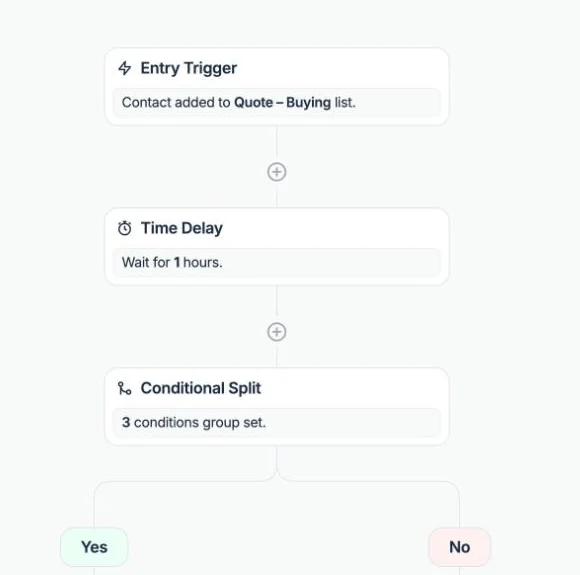
The diagram below shows how a lead moves through the two sequences we run for that firm.
- Quote sentThe quote goes out by email and text.
- Joins a listThe lead joins the buying or selling list.
- Emails followEmails change with location, matter type and engagement.
- OutcomeStays in the sequence up to six months unless they unsubscribe.
One firm's own set-up, from the firm's accounts read on 27 October 2026. Results vary by firm, area and market.
Four weeks is too soon to judge a six-month sequence. Most of these leads are still inside it, so the count of late instructions can only grow. Enquirers give consent on the form, every email carries an unsubscribe link, and the setup follows UK GDPR and PECR rules. The case study has the full build.
Related reading:
- Conveyancing quote software, for the quote side
- Conveyancing marketing services
- Local SEO and AI search and PPC management for solicitors, to bring more enquiries in
- Conveyancing leads and panels, bought leads against your own
Check your own follow-up this week
You can do this in under an hour with what's already in your inbox and CRM.
- Pull the last month of quote requests that didn't instruct.
- For each one, write down what you sent after the quote, and when.
- Check your quote form: is there a clear opt-out box, separate from the privacy policy?
- Check one sent email: is there an unsubscribe link that works without logging in?
- Sort the list by matter type, then draft one useful email for each type.
To see how your quote itself reads to a lead, try our free conveyancing quote builder with your own fees.
Sources
- Legal Futures, "Quotes? What quotes? Most conveyancing firms refuse to give them over the phone", 30 September 2015, reporting TM Group's mystery shop of 100 firms, legalfutures.co.uk. 2015 data. Checked 20 October 2026.
- Information Commissioner's Office, "How do we comply with the PECR electronic mail marketing rules?", negotiations for a sale, ico.org.uk. Checked 20 October 2026.
- The Privacy and Electronic Communications (EC Directive) Regulations 2003, regulation 22, legislation.gov.uk/uksi/2003/2426/regulation/22. Checked 20 October 2026.
- Information Commissioner's Office, same guidance, obtaining contact details, ico.org.uk. Checked 20 October 2026.
- Information Commissioner's Office, same guidance, consent for each type of message, ico.org.uk. Checked 20 October 2026.
- Information Commissioner's Office, same guidance, when people change their mind, ico.org.uk. Checked 20 October 2026.
- Information Commissioner's Office, "A guide to lawful basis", ico.org.uk. Checked 20 October 2026.