
In short
Law firm SEO (search engine optimisation), also called SEO for solicitors, is how an SRA-regulated firm gets found when someone nearby searches for legal help. That covers Google's map results and ordinary results. It also covers AI answers from ChatGPT, the AI search tool Perplexity, and Google's AI Overviews (the AI summary above some results).
We don't promise rankings, because nobody controls them.
What does law firm SEO cover for a solicitors firm?
Being found in the map results, ranking the pages that explain your services, and being named when someone asks an AI tool.
Law firm SEO has four parts, and they overlap. Want to try the basics yourself first? Our guide to SEO for solicitors says what to do in-house and what to pay for.
Local SEO: the map results
This is the map pack, the short list of firms Google shows with a map for a search like "family solicitor near me". It runs mostly on your Google Business Profile, the free listing that puts your firm on Google Maps. Your reviews count too, and so do firm details that match everywhere they appear, SRA number included.
Organic SEO: your practice-area pages
These are the ordinary results under the map, and they rank pages, not firms. So we build one clear practice-area page for each type of work you want enquiries for, rather than one page that lists everything. Our pages for each type of firm show how that differs:
- Conveyancing, with a guide to local SEO for conveyancing solicitors and a case study of a conveyancing firm's lead system
- Wills and probate
- Family law
- Immigration
- Personal injury and claims
Price pages and the SRA Transparency Rules
If you do residential conveyancing, uncontested probate or immigration applications, the SRA Transparency Rules cover your price pages. We treat those pages as part of the SEO work: easy to find, plain and up to date. Our SRA Transparency Rules checklist sets out what the rules ask for.
AI answers: being named by AI tools
This is whether ChatGPT, Google AI Overviews or Perplexity mention your firm when someone asks for a solicitor. We measure it every month.
Client searches: what do people type when they need a solicitor?
Mostly the type of work, often with "near me" or a price word such as "fixed fee" or "quotes".
| Practice area | What people search | Searches a month (UK) |
|---|---|---|
| Conveyancing | conveyancing solicitors near me | 5,400 |
| Conveyancing | conveyancing quotes | 2,400 |
| Family | divorce solicitors | 2,900 |
| Family | fixed fee divorce solicitors near me | 210 |
| Wills and probate | probate solicitors | 2,900 |
| Wills and probate | contentious probate solicitors | 1,000 |
| Wills and probate | fixed fee probate solicitors near me | 320 |
Clients search by type of work, which is why each practice area gets its own page. Family law marketing for solicitors shows how that works for one practice area.
Price words turn up in real searches, so one clear price page can serve these searches and, for services on the Rule 1 list, the SRA Transparency Rules.
Our reading of the figures: "contentious probate solicitors" is a different search from "probate solicitors". It needs its own page.
What these searches cost as Google ads is in PPC for law firms: what clicks cost and how to judge them.
Is SEO still worth it for a solicitors firm?
For most firms, yes, if you can wait months for it. The work now has two goals: be found in Google, and be named by AI tools.
Is SEO being phased out? No. Google's own guidance for site owners says "There are no additional requirements to appear in AI Overviews or AI Mode".[1] The same groundwork serves both routes.
What has changed is how you measure it. Some questions now get answered on the results page, so a visit count tells you less than it used to. We track calls, forms and profile actions (calls, direction requests and website clicks from your Google profile) instead.
Referrals still matter. Someone recommended to you may still look you up before they call. Your profile and your pages are what they find, so search work backs up the recommendation rather than replacing it.
This is one of six law firm marketing services we offer solicitors firms. If you need enquiries this month, paid search is the faster route. Our PPC management for solicitors service runs pay-per-click (PPC) ads on Google and Meta, where you pay for clicks or views.
Law firm SEO
How someone finds your firm now
Three routes end in the same place: a call or a form that your team answers. Local SEO, organic SEO and AI answers each cover one route.
Take a conveyancing firm we work with. Searches that didn't use its name brought 25 Google clicks in the 14 days from 25 August 2026, the first day of Search Console data. They brought 29 in the 14 days from 25 September, then 132 in the 14 days to 22 October.
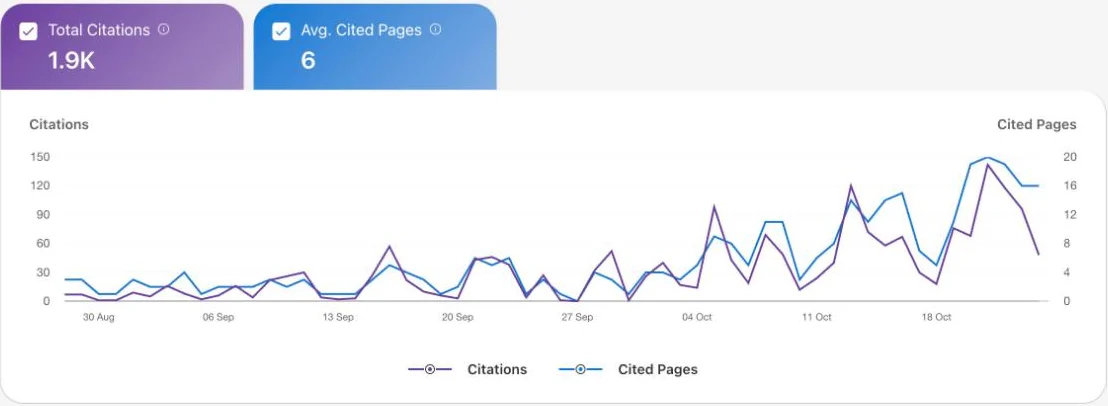
Over three months to 26 October, Bing showed about 1,900 citations of its pages in Microsoft Copilot and partner AI answers. About a fifth of those were for one search on the firm's own name. That's one firm; results vary by firm, area and market.
- Someone needs a solicitorThey search Google, open Maps or ask an AI tool
- Local SEOMap resultsGoogle Business Profile and reviewsOrganic SEOSearch resultsOne page for each practice areaAI answersAI toolsChatGPT, AI Overviews and Perplexity
- Your website, phone or formFirm details match everywhere, SRA number included
- An enquiry your firm answersMeasured: calls, forms, profile actions
How it works
SEO work: how does it run?
Four steps, each signed off by the firm before anything goes live: audit, set up, publish, measure.
Audit
We check your Google profile, your practice-area pages, your reviews and what AI tools say about you today. You get the gaps in writing.
Set up
We fix your profile, categories and firm details, and set up the review request process. You approve each change first.
Publish
We write or rework one page for each practice area you want enquiries for. Your firm checks every page before it goes live.
Measure
Each month you get a short report: calls, forms, Google profile actions and the AI prompt tests. Then we agree what to work on next.
Your Google profile, website and analytics are set up in your firm's name, and your firm owns them. You can remove our access at any time, and if we stop working together, the accounts and the data stay with you.
SEO services for law firms: what's included and what isn't
Included: the setup and ongoing work above. Not included: promised rankings, bought or written reviews, contacting people who haven't asked, or legal advice.
Included in the SEO work
- Google Business Profile setup or clean-up, and ongoing upkeep
- Firm name, address, phone and SRA number matched across directories
- One clear page for each practice area, in plain English, signed off by you
- A review request process and sample wording for your team
- Monthly AI prompt tests in ChatGPT, Google AI Overviews and Perplexity
- A monthly report of calls, forms, profile actions and AI test results
Not included in the SEO work
- Promised rankings or promised AI mentions. Nobody controls them.
- Buying, writing or posting reviews.
- Contacting members of the public who haven't contacted you. Paragraph 8.9 of the SRA Code limits that to current or former clients.[13]
- Buying or reselling enquiries. Every enquiry is yours alone.
- Legal advice. Naelar isn't a law firm, and your firm stays responsible for its own compliance.
Law firm SEO: who it's for and who it isn't
A good fit is an SRA-regulated firm that wants steady enquiries from search and will sign off its own publicity.

Good fit: who SEO suits
You're an SRA-regulated firm with practice areas you want more of, such as family, employment, immigration or wills and probate. Someone at the firm can check pages and review replies. You're prepared to let search build over time.
Not a fit yet: when to wait
You need enquiries this week. Paid search is faster: see our PPC guide for law firms or our PPC management for solicitors service. Or you want reviews written for you, or a promised ranking. We don't do either.
How much does law firm SEO cost for a solicitors firm?
It depends on the number of offices, practice areas and how much work the website needs. We scope it on the intro call.
We don't publish a price, because the work differs a lot from firm to firm. A one-office firm with sound pages needs less than a three-office firm whose website needs rewriting. If the site itself has to be rebuilt, see law firm website design.
Public price data for UK legal SEO is thin. The agency price pages we found are the agencies' own estimates, not surveys of what firms actually pay. Treat any figure you read as a rough guide.
Whoever you talk to, ask these about cost and leaving:
- What exactly does the monthly fee cover, and what costs extra?
- How much notice do we give if we want to stop?
The other questions to ask, with our own answers, are in How to choose a legal marketing agency in the UK.
How do Google reviews work within SRA and consumer rules?
Ask every client the same way, and never pay or reward anyone for a review or write one on a client's behalf. Reply to negative reviews without revealing anything confidential.
The SRA is in favour of firms engaging with reviews. Its page on customer reviews says managing them "can be extremely helpful".[2] Three sets of rules shape how you do it.
| Source | What it says | In practice |
|---|---|---|
| SRA Code of Conduct for Solicitors, paragraph 8.8: publicity must be accurate | "You ensure that any publicity in relation to your practice is accurate and not misleading".[3] See the SRA Code of Conduct for Solicitors. | The SRA's warning notice of 19 December 2024 adds that this "also includes any marketing material used by third parties that you work with".[4] So publicity an agency produces for you counts as yours. |
| Consumer law: Digital Markets, Competition and Consumers Act 2024, Schedule 20 | Lists practices that are unfair in all circumstances.[5] Paragraph 13 covers "Submitting, or commissioning another person to submit or write" a fake consumer review, or one that hides an incentive.[5][8] | In force since 6 April 2025.[6] Business Companion, the Chartered Trading Standards Institute's guidance site, gives "suppressing negative reviews" and "cherry-picking good reviews" as examples of publishing reviews in a misleading way.[7] |
| Google's policy on fake reviews | Google says it takes "fake and/or incentivised reviews and ratings on businesses very seriously".[9] | It can stop a profile getting new reviews, or hide its existing ones, for a set period.[9] |
Reviews: what to do
- Ask every client, at the same stage of the matter, in the same words
- Make it easy, with one link straight to your Google profile
- Reply to good and bad reviews, briefly and in general terms
- Keep a note of when and how each client was asked
Reviews: what not to do
- Pay, discount or reward anyone for a review
- Write or post a review for a client, even with their approval
- Ask only the clients you expect to be happy
- Hide honest negative reviews from your website or marketing
- Mention the reviewer's matter in a reply
Replying to a negative review
The SRA Code says "You keep the affairs of current and former clients confidential".[10] That duty doesn't pause when a client posts a review. A short reply can thank them, say you take feedback seriously, and invite them to contact the firm directly.
A sample request email. Change it to fit your firm, then send it to every client at the same stage.
Dear [client name],
Thank you for choosing us for your [type of matter]. We ask every client for honest feedback, good or bad.
If you're happy to, you can leave a review on our Google profile here: [link]. Please don't include details of your matter. There's nothing offered in return, and it's fine not to.
Kind regards, [your name]
Five-star-only reviews also carry a reputation risk. In April 2026 the Law Gazette reported research by Blind Justice UK, an access to justice charity.[11] It said all 486 client ratings it found on 50 firms' own websites were five stars.[11]
The charity says a one-sided picture like that may breach the SRA's rules on misleading publicity. That's the charity's view, not an SRA finding.
Naelar never writes or posts reviews for anyone. We're not a law firm and this isn't legal advice, so check your review process with your compliance officer (COLP) before you start.
AI visibility for SRA-regulated firms: can ChatGPT and AI Overviews name you?
Sometimes, and nobody can promise it. AI visibility for an SRA-regulated firm means how often AI tools name your firm when someone asks for a solicitor. AI answers change each time you ask. So we ask the same questions several times and measure how often your firm appears, instead of promising a position.
BrightLocal, a company that sells local SEO software, ran the same local prompts again and again in a September 2026 study. It found "Only 20-33% average overlap between result sets on repeat searches".[12] In other words, most of the businesses named changed from one run to the next. The study wasn't about law firms.
It doesn't say which country its business locations were in, and its examples are American. Still, it shows why one screenshot of ChatGPT naming a firm proves very little.
We know of no independent study that shows how AI tools choose which UK solicitors to name. So we'd be wary of anyone who offers you a place in ChatGPT within a month. We test it the same way each time instead:
- A fixed set of prompts a client might type, such as "family solicitor in [your town]"
- Each prompt run several times in ChatGPT, Google AI Overviews and Perplexity
- Every answer recorded: which firms were named, and which pages were cited
- The share of runs that name your firm, tracked over time
Then we work on what those tools pick up: clear practice-area pages, a complete Google profile, and firm details that match across the web.
How do you get your solicitor profile into AI search results?
You can't buy a place, but you can make your firm easy to name. The three things above are the work, and our guide to SEO for solicitors covers what a firm can do itself first.
Pages that answer clients' questions help here too, and our content marketing guide for law firms shows what is worth writing.
For a quick first look, our free AI visibility checker asks ChatGPT and Perplexity one question about solicitors in your town and shows whether your firm is named.
AI answers test: what the tools cited for UK legal marketing questions
We also tested our own field. These are questions firms ask about marketing, not questions clients ask about a legal problem. So they show what kind of page AI tools cite, rather than whether your firm gets named.
On 17 October 2026 we asked 8 UK questions about marketing a solicitors firm, once each, in ChatGPT, Perplexity and Google. That gave 24 answers.
The 5 "how do I" prompts gave 15, for example "how fast should a solicitor respond to a new enquiry". The 3 "which agency" prompts gave 9, for example "best legal marketing agency for small law firms UK".
ChatGPT and Perplexity ran through DataForSEO, a search data service, with web search set to Great Britain, a close stand-in for the apps.
Answers that cited SRA, Ombudsman, Law Society or GOV.UK, by type of question (percent)
Show the numbers
| Type of question | Answers citing a primary source |
|---|---|
| "How do I" (5 prompts) | 10 of 15 |
| "Which agency" (3 prompts) | 0 of 9 |
What we saw:
- For "how do I" questions, the AI answers leaned on primary sources. The SRA was cited in 7 of the 24 answers, more than any other site.
- For "which agency" questions, they cited agency websites and software companies instead.
- Google showed an AI Overview for all 8 UK questions.
- Naelar was named in none of the 24 answers.
Our reading: pages that answer a question plainly and link the rule they rely on are the kind these tools cited. Nobody can promise a mention.
SEO questions from solicitors
How long does SEO take for a solicitors firm?
Slower than paid search, and nobody can give you a firm date. We report monthly, so you can see what's moving.
Our Google profile was suspended. Can you help?
Google decides on reinstatement. We check the profile against Google's guidelines, fix what we find and help you submit an appeal.
Read next
Sources
- Google Search Central, "AI features and your website", last updated 10 December 2025, developers.google.com/search/docs/appearance/ai-features. Checked 17 October 2026.
- Solicitors Regulation Authority, "Customer reviews and comparison websites", 30 September 2024, sra.org.uk/solicitors/resources/fees/customer-reviews. Checked 17 October 2026.
- Solicitors Regulation Authority, "SRA Code of Conduct for Solicitors, RELs and RFLs", paragraph 8.8, sra.org.uk/solicitors/standards-regulations/code-conduct-solicitors. Checked 17 October 2026.
- Solicitors Regulation Authority, "Warning notice: Marketing your services to members of the public", 19 December 2024, sra.org.uk/solicitors/guidance/marketing-public. Checked 17 October 2026.
- Digital Markets, Competition and Consumers Act 2024, Schedule 20, paragraph 13, legislation.gov.uk/ukpga/2024/13/schedule/20. Checked 17 October 2026.
- Digital Markets, Competition and Consumers Act 2024, Schedule 20, commencement note for paragraph 13, legislation.gov.uk/ukpga/2024/13/schedule/20. Checked 17 October 2026.
- Business Companion (Chartered Trading Standards Institute), "Reviews and endorsements", October 2025, businesscompanion.info (reviews and endorsements). Checked 17 October 2026.
- Competition and Markets Authority, "Fake reviews (CMA208)", 4 April 2025, gov.uk/government/publications/fake-reviews-cma208. Checked 17 October 2026.
- Google, "Business Profile restrictions for policy violations", undated, support.google.com/business/answer/14114287. Checked 17 October 2026.
- Solicitors Regulation Authority, "SRA Code of Conduct for Solicitors, RELs and RFLs", confidentiality, sra.org.uk/solicitors/standards-regulations/code-conduct-solicitors. Checked 17 October 2026.
- Law Gazette, "Law firms accused of misleading clients with blanket five-star reviews", 21 April 2026, lawgazette.co.uk. Checked 17 October 2026. The findings are Blind Justice UK's own analysis.
- BrightLocal, "Local AI visibility study", 16 September 2026, brightlocal.com/research/local-ai-visibility-study. Checked 17 October 2026. Vendor study (BrightLocal sells local SEO software). Not specific to law firms.
- Solicitors Regulation Authority, "SRA Code of Conduct for Solicitors, RELs and RFLs", paragraph 8.9, sra.org.uk/solicitors/standards-regulations/code-conduct-solicitors. Checked 17 October 2026.
Tell us how your firm is found today
It's a 15-minute call, the first conversation is free, and we reply within one working day.
Book an intro call