


In short
For a conveyancing firm we work with, we built a quote page, a CRM and six months of follow-up emails. From 2 September to 26 October 2026 it took 1,238 leads, and leads from its quote page got their quote email in a median of 6 seconds.
Ad traffic changed too, and this is one firm's result: results vary by firm, area and market.
This page is for partners and practice managers at residential conveyancing firms. It shows what we built, what the firm saw, and what changes from one firm to the next. The firm isn't named. The figures come from its own ad accounts, analytics, CRM and email tool, with the date range for each. We say what they can't tell you and what didn't work.
What problem does a quote system solve?
It answers two common problems in conveyancing: slow replies to quote requests, and leads the firm rents rather than owns.
Slow replies
Speed matters to buyers. In a YouGov poll of 2,054 consumers for Thirdfort, 45% named slow response as their main complaint about conveyancers.[1] An older mystery shop of 100 firms by TM Group found most firms didn't follow up after a quote call.[2] That study is from 2015, so treat it as a sign of habit, not a current measure.
Rented leads
Rented leads are the other side. A lead seller may sell to rival firms in the same area: one seller's own page says up to four firms advertise per campaign. That page doesn't say whether an enquiry goes to one firm or several.[3] Panel and referral deals add a disclosure step too.
The SRA Code says clients are told about any fee sharing arrangement relevant to their matter (paragraph 5.1).[4]
Leads that aren't ready
Conveyancing leads are also hard to convert. Property chains hold people up, and many who ask for a quote aren't ready yet: they're comparing prices. A single quote email gives the firm one chance. Our pillar page on conveyancing marketing services compares each source of quote requests in more detail.
What did we build for the firm?
We built six connected parts, and every one of them sits in the firm's own name.
- A landing page that collects and qualifies enquiries for a purchase, a sale, a sale and purchase together, or a remortgage.
- An automatic quote. The lead gets the quote with a personalised email in a median of 6 seconds, plus a text message and a branded brochure as a PDF. Nobody at the firm writes quotes by hand any more.
- A personalised CRM. The firm's team can edit a lead's details, amend a quote quickly and resend it.
- Six months of email nurture for landing-page leads who haven't instructed. The emails change with the lead's location, matter type, and how they engaged with earlier emails. They're written to keep in touch without spamming.
- Traffic around it. The website is optimised for AI search and for Google and Bing, and Meta ads and Google Ads run alongside. Bing ads ran from 8 October and were paused by 27 October.
- Ownership. The firm owns the landing page, the CRM, the ad accounts and its other accounts.
Our guide to conveyancing lead nurture emails shows how a sequence like this is planned. See local SEO and AI search and lead generation for the traffic parts.
The firm also gets leads from Compare My Move, a quote comparison site. We automated that source too: its leads get their quotes from the same quote system as the landing page's leads. Compare My Move leads get only that first automated quote. They never enter the nurture emails, because the firm didn't collect their details itself.
What goes into each quote
Every quote has the same main sections: government charges, legal fees and disbursements. Under those sit the firm's own fees, which depend on how the firm works and which fees apply to that lead.
The system can run any calculation the firm's fee scale needs. It fetches live rates, looks up the property price, and works out government charges such as Stamp Duty Land Tax and HM Land Registry fees. Then it puts the quote into the firm's branded PDF brochure.
The quote and CRM parts are now a service of their own: conveyancing quote software. For what a firm needs from the CRM side, read our guide to a conveyancing CRM.
What were the results?
From 2 September to 26 October 2026, the system took 1,238 leads and the CRM recorded 66 instructions. The figures below come from the firm's own accounts, read on 27 October 2026. A lead is an enquiry; an instruction is a lead who went ahead.
This is one firm over eight weeks, not a typical result or a promise. Results vary by firm, area and market. Screenshots are cropped, and we blacked out anything that could name the firm or a person.
What happened, and when?
The data runs from 2 September to 26 October 2026 unless a row says otherwise. The new quote page is the one change that sits in the middle of it.
- The recorded run startsThe CRM figures in this guide start here.
- The old quote page7.0% of page loads ended in a lead (155 of 2,200).
- The new quote page goes liveIt sends the quote automatically.
- The buying follow-up emails startThe selling sequence follows on 21 October.
- Compare My Move leads quoted automatically442 of 443 were quoted, from 6 to 26 October.
- Bing Ads beginThey were paused by 27 October.
- The recorded run endsThe firm's accounts were read on 27 October.
One firm's own records. Results vary by firm, area and market.
The headline figures, each explained below. Dates are 2 September to 26 October 2026 unless a row says otherwise.
| Measure | Figure |
|---|---|
| Time to the quote email | Median 6 seconds, 90% within 19 seconds (904 quote emails) |
| Leads in the CRM | 1,238 |
| Quote page visits that became leads | 7.0% on the old page, 9.9% on the new page in its first 14 days, 11.4% in its latest 14 (9 September to 26 October 2026) |
| Instructions recorded in the CRM | 66. The CRM undercounts, so this is a floor |
| Cost per lead | Meta £14.04, Google about £30, Bing £49.73 (1 September to 26 October 2026; Bing 8 to 27 October) |
How fast did quotes go out?
The quote email reached the lead in a median of 6 seconds, the middle time, so half were faster. And 90% arrived within 19 seconds. That covers 904 quote emails. The quote text followed in a median of 7 seconds.
Compare My Move leads went through the same engine. From 6 to 26 October, 442 of 443 were quoted automatically, in 17.8 seconds on average.
Where did the leads come from?
| Source | Leads | Instructions recorded | Rate |
|---|---|---|---|
| Meta ads (Facebook and Instagram) | 564 | 30 | 5.3% |
| Compare My Move | 437 | 20 | 4.6% |
| Google Ads | 114 | 9 | 7.9% |
| All sources | 1,238 | 66 | 5.3% |
Five smaller sources are left out of the table because none had enough leads to rate. The All sources row includes all five.
- Not recorded (first weeks): 77 leads, 0 instructions.
- The firm's main website: 21 leads, 3 instructions.
- Microsoft (Bing) Ads: 14 leads, 1 instruction.
- Email to past enquirers: 10 leads, 3 instructions.
- Search, straight to the quote page: 1 lead, 0 instructions.
By matter type, the leads were 834 purchases, 220 sales, 164 sales and purchases together, and 20 remortgages. September brought 253 leads and October, to the 26th, brought 985, including 437 from Compare My Move, whose feed started on 6 October.
The CRM undercounts instructions, because it only holds the ones staff mark as converted. The firm's own count for October was 101 clients to the 26th, against 62 October leads marked instructed in the CRM. Not every one of those clients need have come from these leads. So read every instruction figure here as a floor.
Did the new quote page convert better?
On these figures, yes, though not only because of the page. On the old quote page, 7.0% of visits ended in a quote request. On the new page it was 9.9% in its first 14 days and 11.4% in the latest 14.
| Period | Visit to lead |
|---|---|
| Old page, 9 to 22 September | 7.0% (155 leads from 2,200 visits) |
| New page, 24 September to 7 October | 9.9% (236 leads from 2,395 visits) |
| New page, 13 to 26 October | 11.4% (377 leads from 3,293 visits) |
Over the same weeks, Meta moved from its own instant forms to sending people to the quote page. Google Ads leads also rose from 14 in September to 100 in October, to the 26th. A different mix of visitors can move the rate on its own.
What did each lead cost?
Of the three ad channels, Meta gave the cheapest leads and Bing the dearest. Google's leads had the highest recorded instruction rate of the three, 9 of 114, but numbers this small can move a lot by chance. The Bing campaign was paused by 27 October.
| Channel and dates | Cost per lead |
|---|---|
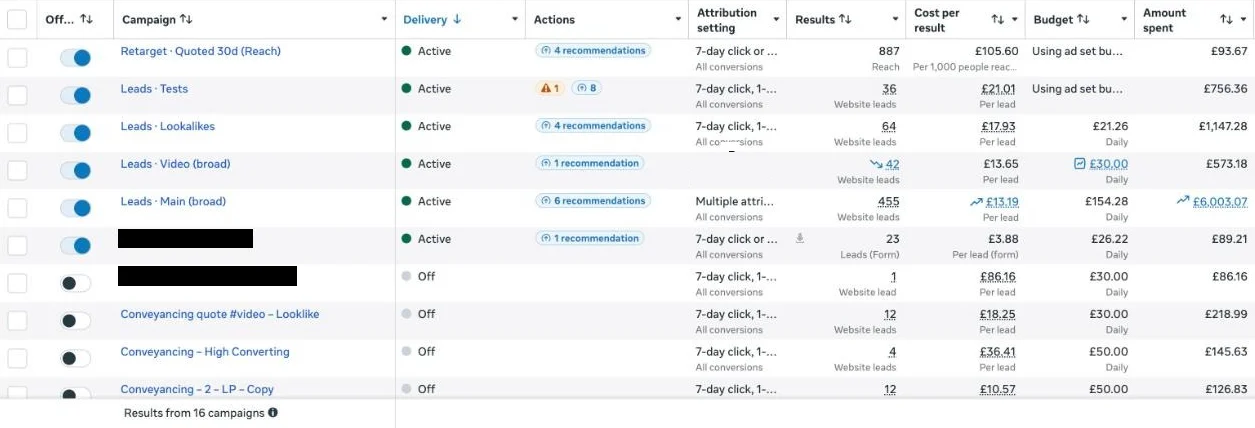
| Meta ads, 1 September to 26 October | £14.04 (£9,478.88 spend, 675 leads) |
| Google Ads, 1 September to 26 October | about £30 (£3,417.65 spend, 114 leads) |
| Microsoft (Bing) Ads, 8 to 27 October | £49.73 (£696.18 spend, 14 leads) |
Spend divided by the instructions the CRM recorded gives £315.96 per instruction for Meta and £379.74 for Google. The CRM's count is incomplete, so the true figures may be lower. The average fee on a recorded instruction was £817.60. Recorded instructions came a median of 2.3 days after the quote.
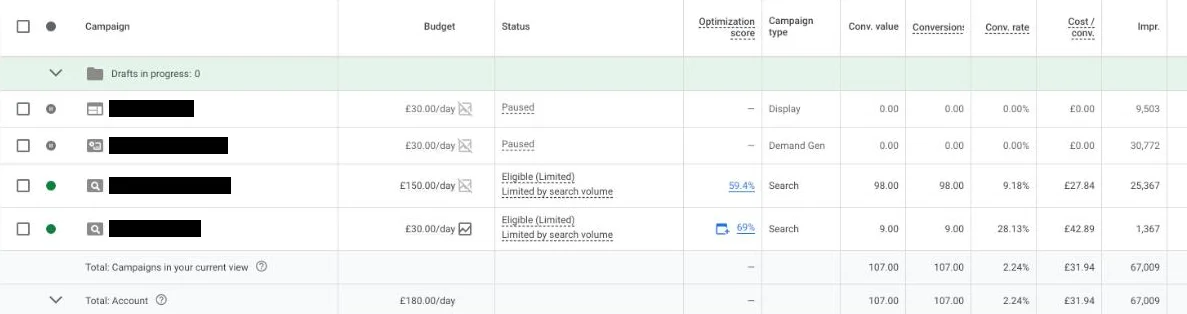
On Google, the main search campaign spent £2,728.13 on 1,067 clicks, about £2.56 a click. Its conversion rate was 9.18%. Across the whole account, 85 of the 107 conversions Google counted came from phones.
Did the follow-up emails work?
People opened them, and some instructed late. From 28 September to 26 October about 4,500 emails were delivered. The unique open rate was 55.5% (that share of delivered emails was opened at least once), and there was one spam complaint. Some mail apps load images on their own, so open rates can read high.
Of 710 buying leads quoted since the buying sequence began, 49 instructed. Six of them did so more than 7 days after the first quote, the latest after 23 days. The other 43 instructed within 7 days. There was no group without the emails to compare, so we can't say how many instructions the emails won.
The click rate was 0.2%, which we expected: the emails ask people to reply, not to click. How to write and space them is in our conveyancing lead nurture emails guide.

What happened in search?
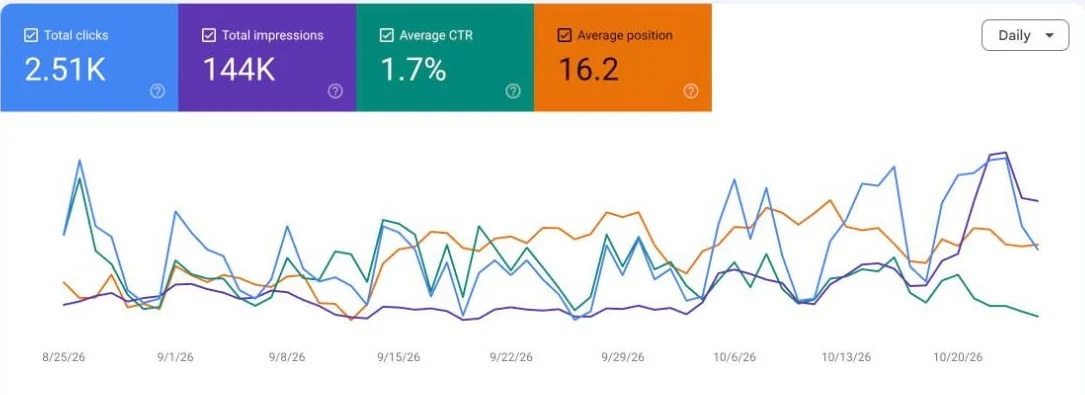
Searches that didn't use the firm's name brought more visits in October. In 14-day windows, those clicks went from 25 (25 August to 7 September) to 29 (25 September to 8 October), then 132 (9 to 22 October).
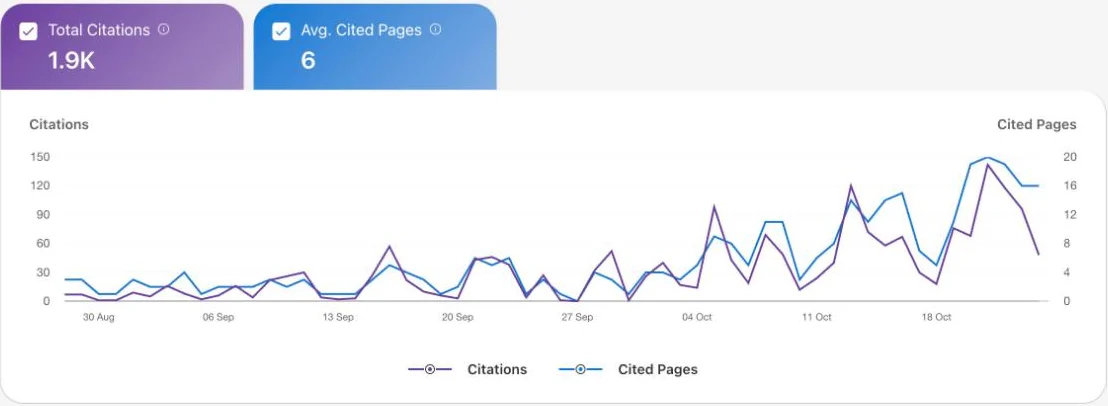
Across 25 August to 25 October the site had 2,508 Google clicks, 863 of them from searches for the firm's name. Google hides some rarer searches, so the non-branded counts above cover only the searches it shows. Over three months to 26 October, Bing's AI report counted about 1,900 times the site was cited in Microsoft Copilot and partner AI answers. Of those, 420, about a fifth, came from one search for the firm's name.
What didn't work?
- Two Google tests, Display and YouTube (Demand Gen), spent £303.48 and brought no conversions.
- Both Google tests are paused.
- Bing Ads cost £49.73 a lead, against about £30 on Google, and the campaign was paused by 27 October.
- Bing's own tag counted only 3 conversions, against 14 leads in the CRM, because consent isn't passed to it.
- Meta leads, as Meta counts them, cost more after the new page went live: £15.51 each from 24 September to 26 October, against £7.18 from 5 August to 22 September.
- Before, most Meta leads came through Meta's own instant forms (166 of 283). After, almost all came through the quote page (492 of 515).
- The first 77 leads have no source, because source tracking started after the page did.
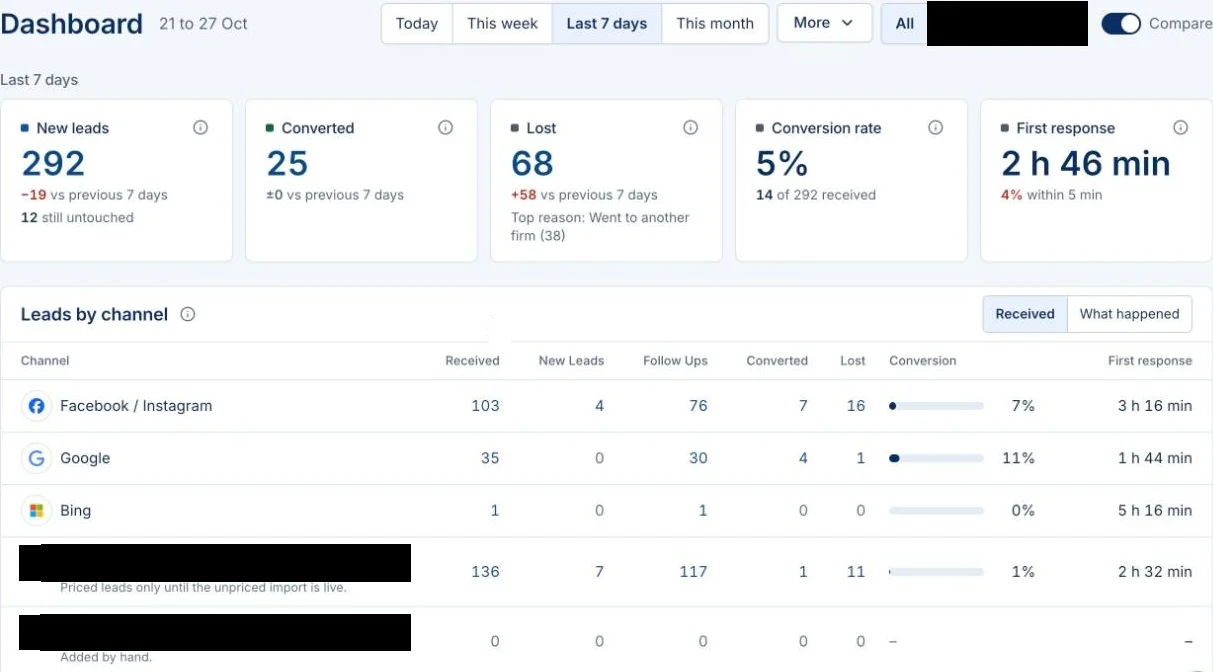
- People still answer slowly. In the week of 21 to 27 October, the CRM showed a first response time of 2 hours 46 minutes, with 4% of leads answered within 5 minutes. The automatic quote covers that gap, but it doesn't replace the call.
What could we not measure?
- Google Business Profile figures: they were not available.
- What Compare My Move leads cost: that was not available either.
- Quote times before the new page went live.
- Every instruction: the CRM undercounts them, so any cost per instruction is an upper bound.
What did it take from the firm?
The firm's own pricing and a person who keeps an eye on the CRM. In return, the team no longer types quotes. An automatic quote can only be as right as the fee scale behind it, so the firm's fees for each matter type come first. The brochure needs the firm's own details, written the way it wants clients to read them.
Someone at your firm needs to own the CRM day to day. When a lead's details change, they amend the quote and resend it. That's the step a lead sees as a reply from a real firm.
On the legal side, enquirers give consent on the form and every email carries an unsubscribe link. The setup follows UK GDPR and PECR rules, as the ICO sets out for email marketing.[5] Your compliance officer should still check the wording on your own forms and emails.
What changes from firm to firm?
Almost everything that feeds these figures. A firm in a busy commuter town and a firm in a rural county face different searches, different ad prices and different rivals.
- Matter mix. A firm doing mostly remortgages sees different enquiries from one doing mostly purchases.
- Your fees against local rivals. The quote goes out fast, but the person still compares it.
- How quickly your team amends and resends a quote when something changes.
- Where your traffic comes from. People who searched for a conveyancer behave differently from people who saw an ad.
- The market. When fewer homes sell, there are fewer quote requests to win.
So we don't quote these figures as a target for a new firm. We set up the same measures for each firm and report its own numbers.
Work out your own figures
You can measure these numbers for your firm this week, with no outside help.
- Pick one month and one page where people ask you for a quote.
- From your analytics, note how many people visited that page.
- Count the quote requests that page produced, then divide by the visitors. That's your visitor-to-lead rate.
- Divide each channel's spend by the instructions it brought, and compare that with your average fee.
- Write down how long each quote took to reach the person, from the enquiry to their inbox.
To see what a fast quote could look like for each matter type, try our free conveyancing quote builder with your own fees.
Sources
- Legal Futures, "Nearly half of homebuyers say lawyers are too slow in responding", 1 November 2023, reporting a YouGov poll for Thirdfort, legalfutures.co.uk. Checked 20 October 2026.
- Legal Futures, "Quotes? What quotes? Most conveyancing firms refuse to give them over the phone", 30 September 2015, reporting TM Group's mystery shop of 100 firms, legalfutures.co.uk. 2015 data. Checked 20 October 2026.
- Legal Brokers, "Conveyancing leads" (a lead seller's own page), legalbrokers.com/conveyancing-leads. Checked 20 October 2026.
- Solicitors Regulation Authority, "SRA Code of Conduct for Solicitors, RELs and RFLs", paragraph 5.1, sra.org.uk/solicitors/standards-regulations/code-conduct-solicitors. Checked 20 October 2026.
- Information Commissioner's Office, "How do we comply with the PECR electronic mail marketing rules?", ico.org.uk. Checked 20 October 2026.