


The short answer
An AI receptionist for law firms answers calls or chats when your team can't. It asks your screening questions, books a call and writes the details to your CRM. It should never give legal advice, put a value on a case or sign anyone up. The first real conversation about the case still happens with a person at your firm.
This guide is for managing partners and intake leads at small California firms who miss calls at night and over lunch, and keep getting pitched AI answering. If a person already answers every call within a few rings, nights included, you probably don't need one. If you're still choosing the system behind it, read our guide to legal intake software first.
What does an AI receptionist for a law firm do?
It's software that answers your phone or website chat, in a natural voice or in text, from a script your firm writes. It takes the calls your team can't. Those are the after-hours calls and the overflow when every line is busy, which go to voicemail today.
Vendors also sell it as AI intake for law firms, or an AI answering service. Under any of those names, a good setup does five jobs.
- It answers after hours and when your lines are full, and says right away that it's automated.
- It asks your screening questions, in your order, and keeps the answers.
- It books a call with intake or an attorney into a real calendar slot.
- It writes the caller's details and answers into your CRM as a new record.
- It texts a short summary to whoever is on call that night.
The last job is the one we'd fight hardest for. A CRM record created at 11 p.m. helps nobody until the morning. A text to the on-call person means someone can decide tonight whether the call can wait.
The screening questions are the ones your intake team already asks. For an injury firm that means what happened, when, in which county, the injuries and treatment so far, and whether they've signed with another lawyer. Ask for the names of the other people involved first, and keep the story short until a conflict check has run. The section on conflicts below explains why.
If those criteria live only in people's heads, write them down first. You can start from our case-criteria worksheet for personal injury firms.
How does an AI receptionist work?
It turns the caller's speech into text, works out what to say next from your script, and speaks the answer back. It does this in a second or two, so the call sounds like a conversation. Your phone number is set to forward to the platform at night or when your lines are busy.
The same agent can do things during the call, not only talk. It can look up free slots in your calendar, book one, and create a record in your CRM. That is why the setup around the agent matters more than the voice. A good voice on top of a bad calendar still books nobody.
What is AI intake for law firms?
AI intake is an AI agent set up to run your intake questions, not only to take a message. It asks about the case type, the dates and the other parties, and it saves the answers as fields in your CRM.
An AI receptionist answers and routes the call. AI intake goes further into screening. Most vendors sell both under either name.
The vendors show the range:
- Intaker says its tool captures "case type, urgency, location".[24]
- Frontdesk's law-firm agent "runs conflict-check questions" and books a paid consultation.[2]
- Clio's Grow AI, added in August 2026, has agents that "answer common questions, capture information and begin the intake process automatically".[25]
The more an agent screens, the more it needs supervising. Keep the decision to take a case with a lawyer, as the next section sets out. Test the screening on your own case types before you trust it.
The system the answers land in matters as much as the agent, so see our guide to legal intake software. Pricing is under what it costs below.
What should an AI receptionist never do?
It should never give legal advice, say what a case is worth, promise an outcome or sign anyone up on its own. Callers ask all four questions. The script decides what the agent says back.
| The caller says | What the agent should do |
|---|---|
| "Do I have a case?" | Say a person at the firm will look at it, and book that call. |
| "What's my case worth?" | Say it can't answer that, and that an attorney will talk it through. |
| "Will you take my case?" | Say no decision is made on this call, and give the time of the callback. |
| "Send me the paperwork tonight." | Take the details and pass the request to the on-call person. |
| "I'm still at the hospital." | Stop screening and text the on-call person right away. |
| Anything that sounds like danger | Tell the caller to hang up and call emergency services. |
Some products go further than this. Intaker says its tool can "schedule meetings, connect calls, and sign clients in chat".[1]
Collecting the names of other parties is useful. Deciding there's no conflict, or that the firm takes the case, is a lawyer's call.
The State Bar of California's 2026 AI guidance lists "autonomously facilitating client intake" as an example of agentic AI.[3] It says lawyers must not let such systems "communicate legal advice" without meaningful lawyer supervision.[4] You can read the State Bar's practical guidance on generative AI in full.
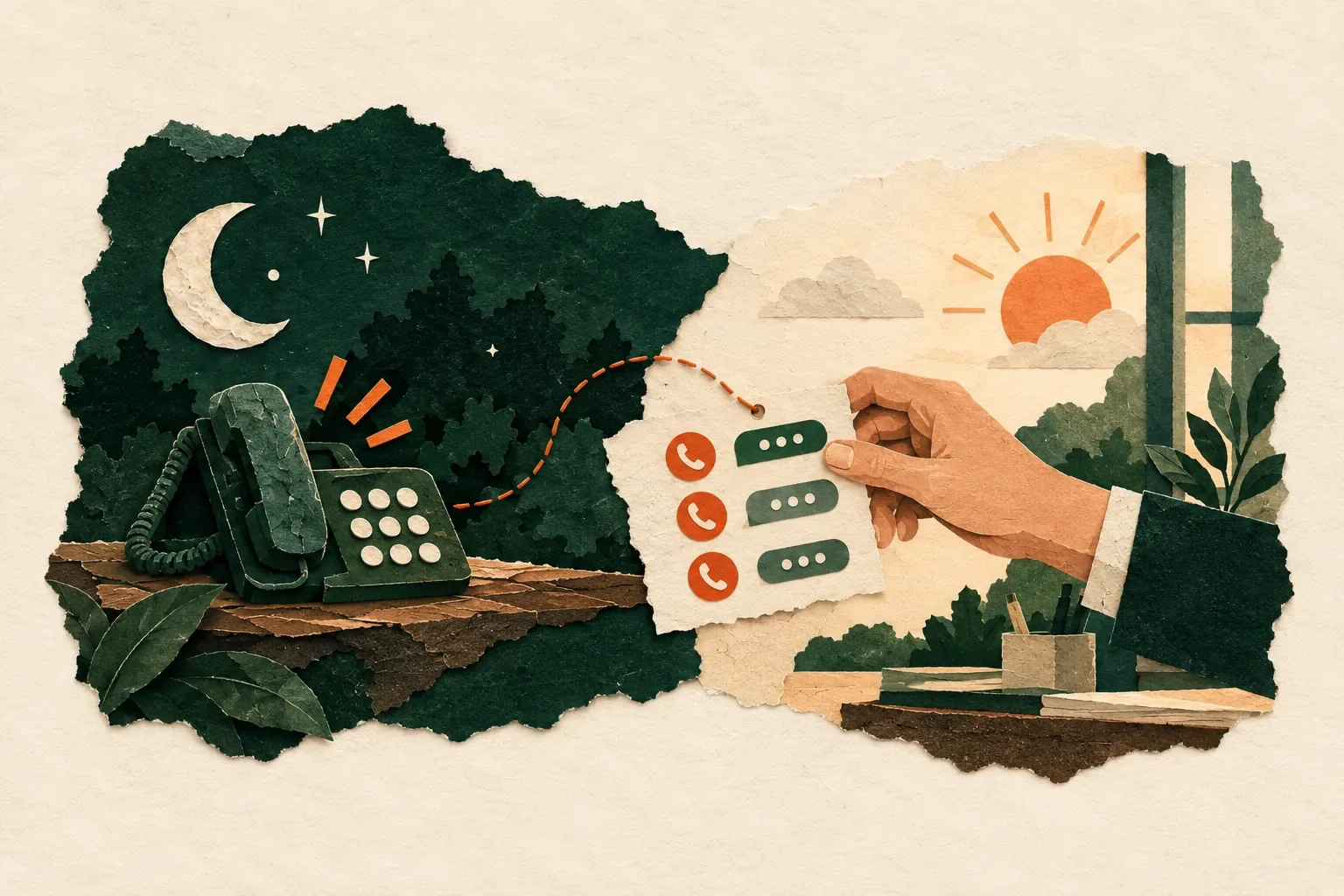
AI receptionist, answering service or remote intake staff?
Use the AI for nights and overflow, where the alternative is voicemail. Use people for calls that are long, upset or confusing, and for anything that needs judgment.
| Question | AI receptionist | Human answering service | Remote intake staff |
|---|---|---|---|
| Who answers | Software, reading your script | A person at the answering company | Your own remote staff, working in your CRM |
| When | Whenever the line is switched over to it | Depends on the plan you buy | The shifts you set |
| Screening | Your questions, asked the same way every time | Depends on the service, from messages to full intake scripts | Full screening, with follow-up questions |
| Upset or confused callers | The weak spot. Smith.ai sells a live agent as a per-call add-on.[19] | A person, though not one from your firm | A person who knows your firm and its cases |
| How it's priced | A monthly plan sized by call volume, at Smith.ai[20] | By receptionist minutes at Ruby[21] | By hours worked |
| Good fit | Nights, weekends and overflow | Daytime cover when the front desk is busy | Firms with steady inquiry volume all day |
You can combine them. The AI takes the night calls, and a person calls everyone back first thing. Our page on offshore staffing explains how that second half works.
For live answering services and what they charge, read legal answering services compared. Every answered call also needs a record to land in, which is what intake and CRM setup covers.
What a good after-hours call sounds like
This is the order we'd script for a personal injury firm. The words change by firm and practice area. Keep the order even when you change the words.
- Answers and says what it isThe agent answers quickly and says what it is: "You've reached [firm name]. I'm the firm's automated assistant, not a person or a lawyer."
- Says the call is recordedIt says the call is recorded and asks if that's OK. If the caller says no, it offers a callback from a person and ends the call.
- Checks it is a new caseIt asks whether the call is about a new case. Current clients, other lawyers and medical offices leave a message for the right person instead.
- Takes the other parties' namesIt takes the names of the other parties, such as the other driver, before any details of what happened.
- Asks your screening questionsIt asks the rest of your screening questions in your order, and lets the caller finish each answer.
- Stops if it sounds urgentIf anything sounds urgent, it stops screening and texts the on-call person at once.
- Reads the number back and booksIt reads the callback number back, then books a slot in your intake calendar and says when to expect the call.
- Writes the CRM recordIt writes a CRM record with the source, the answers and a link to the recording.
- Texts the on-call personIt texts the on-call person a summary: name, number, what happened and the booked time.
Notice what's missing. The caller never hears an opinion about their case. If a vendor's demo gives one, change the script or change the vendor.
The caller may also get a confirmation text. Ask for permission on the call first, and keep a record of the yes. Our speed to lead guide for personal injury firms covers the rules on texting new inquiries.
Where AI receptionists go wrong
Test for each of these before launch. The test call at the end of this page covers most of them.
- It mishears a name or a phone number, on a bad line or with a strong accent, and nobody can call back. Have it read the number back before the call ends.
- The caller switches to Spanish. Some vendors sell this, and Smith.ai lists "Conversational fluency in English and Spanish".[5] If your firm takes calls in Spanish, test the agent in Spanish.
- Current clients, other lawyers and medical offices get screened as if they were new leads. A first question about whether the call is a new case sorts them out.
- A long, upset caller keeps getting questions when they need a person. Give the agent a point where it stops screening and books a callback.
- It makes up answers it was never given, such as your fees, hours or case types. Give it a short list of facts and have it pass anything else to a person.
California rules to check before you switch it on
Four sets of rules touch an AI receptionist in California. As we read them, none bans the tool, but each one changes how you set it up. Naelar isn't a law firm and doesn't give legal advice. Treat this section as a list of questions for your ethics counsel.
| Rule | What it covers | What to set up |
|---|---|---|
| Business and Professions Code 17941[6] | Bots online that mislead people about being a bot | Say it's an AI in the first sentence, on every channel |
| Penal Code 632 and 632.7[9][10] | Recording a call without every party's consent | Say the call is recorded and get a yes before screening. Decide what happens on a no |
| FCC ruling, February 2024[12] | AI-generated voices on calls you make | Let the AI answer, and have a person make the callbacks unless you hold consent |
| State Bar guidance, Rules 1.18 and 5.3[3] | Confidentiality, prospective clients and supervision | Read the vendor's data terms, take other parties' names first, and listen to a sample of calls each week |
The four sections below give each rule with its source.
Telling callers it's an AI (B&P 17941)
California's bot law is Business and Professions Code section 17941.[6] It bars using a bot online to mislead people about its artificial identity, to get them to buy something.[6] There's no liability if the bot discloses that it is a bot.[6] That disclosure has to be "clear, conspicuous" and designed to let people know.[7]
The law defines a bot as an "automated online account".[8] Online means public-facing websites and apps, under section 17940.[8] A chat agent on your website sits much closer to that definition. Whether a phone call counts isn't settled by the text.
We'd disclose on every channel anyway, in the first sentence. We'd rather a caller hang up at the start than feel tricked halfway through.
Recording calls (Penal Code 632 and 632.7)
Penal Code section 632 covers recording a confidential communication without the consent of all parties.[9] A communication is confidential if any party could reasonably want it kept between the parties.[9] Someone describing a crash and their injuries to a law firm may well expect that. The fine can reach $2,500 per violation.[9]
For calls from mobile phones, section 632.7 also asks for every party's consent, whatever the subject.[10] Section 637.2 lets a caller sue for $5,000 per violation.[11]
If the platform records or transcribes calls:
- The agent should say so in its opening lines and get a yes.
- Decide in advance what happens when a caller says no.
- Ask counsel whether the opening line should also name the company that stores the recording.
AI-voice callbacks (FCC, 2024)
In February 2024 the FCC confirmed that the TCPA's limits on "artificial or prerecorded voice" cover AI-generated voices.[12] It said callers must get prior express consent before making such a call.[12] The ruling is on the FCC's website.
That ruling is about calls you make. It matters once the agent starts calling people back, or chasing someone who hung up halfway. Let the AI answer, and have a person make the callbacks.
If you do want AI callbacks, ask for consent on the first call and keep the record.
Confidentiality, conflicts and supervision
The State Bar's 2026 Practical Guidance replaces its 2023 version and adds agentic AI.[3] It says not to put confidential client information into an AI tool that risks its confidentiality, without informed client consent.[13] The guidance is short enough to read in one sitting.
A caller to your intake line isn't a client yet. Under Rule 1.18, they can still be a prospective client.[14] The duty of confidentiality applies even if you never take the case.[14] So read the vendor's data terms: who can hear recordings, how long transcripts are kept, and whether your calls train its models.
Under Rule 1.18(c), what a caller tells the agent can also stop your firm acting against them in the same or a substantially related matter.[15] That bites if they turn out to be on the other side of a case you already have.
The rule still lets the firm act if it "took reasonable measures to avoid exposure to more information than was reasonably necessary".[16] Two more conditions apply:
So have the agent take the names of the other people involved first, and keep the story short until someone runs the conflict check.
Rule 5.3 asks managing lawyers for measures giving "reasonable assurance" about the conduct of nonlawyers.[17] It covers people "whether or not an employee of the same law firm".[17]
The State Bar's AI guidance applies the same idea to AI. It asks supervisors to "make reasonable efforts to provide reasonable assurance" about how they're used.[18] In its confidentiality discussion, it adds that supervision "must correspond to the level of system access and autonomy".[13] An agent answering alone at 2 a.m. has plenty of both.
In practice:
- Someone at the firm listens to a sample of calls each week and fixes the script when something goes wrong.
- Write a policy on AI use. The State Bar's guidance also says managerial lawyers should set clear policies on AI use.[18]
- Take the policy, the call script and the vendor's data terms to your ethics counsel.
What AI answering services for law firms say they do
Everything below comes from each company's own website or launch coverage, read on October 12, 2026. These are vendor claims. We list them so you know what to ask, and this isn't a ranking.
| Vendor | What its own page says |
|---|---|
| Smith.ai | Sells a general AI receptionist, not one built only for law firms. It says every lead is captured, "even on weekends and holidays".[22] It connects to Clio Grow, Clio Manage, HubSpot and Salesforce.[23] |
| Intaker | Built for law firms. It covers "chat, text, LSA, WhatsApp, Meta, and phone" from one platform.[24] |
| Clio Grow AI | Clio added Grow AI to Clio Grow in August 2026. Clio says it includes "Phone, email and web chat agents that answer common questions, capture information and begin the intake process automatically".[25] If your firm already runs on Clio, it's the obvious one to test first. |
| Ruby | The useful contrast. It says it "uses live, human receptionists" rather than an AI voice that runs the call.[21] |
| Frontdesk | Has a law-firm version that screens callers, captures matter type and jurisdiction, and books a paid consultation.[2] |
When we read that page, we found nothing on recording consent, AI disclosure or State Bar rules. Ask any vendor how it handles those before you sign.
What does an AI receptionist cost?
Vendors price by the call, the month or the converted lead. These are the prices we read on October 20, 2026. The Clio figure comes from a LawSites report of August 20, 2026. They change, so check each page.
| Vendor | How it prices | What its page said |
|---|---|---|
| Smith.ai, AI receptionist | Monthly plan sized by calls, then a charge per extra call | Free: 25 calls a month, then $3.00 a call.[20] Pro: $150 a month, about $2.00 a call at 2 to 3 calls a day.[20] Enterprise: $500 a month, about $1.67 a call at about 10 calls a day.[20] |
| Upfirst, AI receptionist | Monthly plan with a set number of calls | Starter: 30 calls for $24.95 a month, then $1.50 for each extra call.[26] |
| Clio Grow AI, AI intake inside Clio Grow | Per converted lead | LawSites reports $25 for each converted lead, and no charge if the lead does not convert.[27] |
None of these prices includes setup, your phone number, texting fees or the time someone spends on the weekly call review. Ask each vendor for a written first-year total. For human answering services and their prices, read Legal answering services compared. For cost per call and the costs a price list leaves out, read our guide to AI intake cost.
How Naelar builds an AI receptionist
We build AI receptionists on a voice or chat platform chosen with your firm, connected to your CRM with n8n, a workflow tool. How a build runs, what it never does and who owns it are on our AI and automation page.
Callers also ask ChatGPT and Perplexity for a lawyer before they call anyone. Our free AI visibility checker shows whether those two name your firm in your city.
Questions people ask
Can an AI receptionist give legal advice?
It shouldn't. Script it to collect facts, book a call and pass anything about the case to a person. The State Bar of California's 2026 guidance says lawyers must not let agentic AI communicate legal advice without meaningful lawyer supervision.[4]
Do callers have to be told they're talking to an AI?
California's bot law, Business and Professions Code section 17941, covers bots online.[6] Its text doesn't settle whether a phone call counts. We'd disclose on every channel in the first sentence anyway.
Can an AI receptionist record calls in California?
Only with consent. Penal Code section 632 needs every party's consent to record a confidential call.[9] Section 632.7 asks the same for calls from mobile phones, whatever the subject.[10] So have the agent say the call is recorded and ask for a yes, and check the exact wording with your ethics counsel.
How much does an AI receptionist cost?
It depends on how the vendor charges and how many calls you send it. Legal answering services compared lists published prices with the date we read them. We don't publish a price for our builds.
Will an AI receptionist replace my intake staff?
No. It covers the hours nobody answers and writes up what it heard. A person still calls back, screens the case properly and decides whether to take it.
Before you buy: a 20-minute test call
Ask any vendor for a demo line set up with your own script. Call it one evening as a pretend caller, then check what lands where.
- Listen to the opening. Does it say it's automated, and that the call is recorded?
- Say no to the recording and see what it does next.
- Ask "Do I have a case?" and "What's my case worth?" It should decline both and offer a call with a person.
- Read your number back fast, the way a stressed caller would. Check the CRM record has it right.
- Call once in Spanish, if your firm takes Spanish-speaking clients.
- Say you're calling from the hospital. Time how long the on-call text takes to arrive.
- Hang up halfway through. Check whether a record still lands in your CRM.
- Read the record and the summary text. Could your intake lead call back from them without playing the recording?
If it fails any of these, fix the script before launch. If the script can't fix it, try another vendor.
Sources
- Intaker (law firm intake software vendor), home page, intaker.com. Checked October 12, 2026. Vendor claim.
- Frontdesk (AI receptionist vendor), "AI Receptionist for Law Firms", myaifrontdesk.com/ai-receptionist/law-firms. Checked October 12, 2026. Vendor claim.
- State Bar of California, Standing Committee on Professional Responsibility and Conduct, "Practical Guidance for the Use of Generative Artificial Intelligence in the Practice of Law", 2026, agentic AI section, calbar.ca.gov. Checked October 12, 2026.
- Same guidance, on legal advice by agentic systems, calbar.ca.gov. Checked October 12, 2026.
- Smith.ai (receptionist and answering vendor), AI Receptionist page, bilingual call handling, smith.ai/ai-receptionist. Checked October 12, 2026. Vendor claim.
- California Business and Professions Code section 17941(a), official text at leginfo.legislature.ca.gov, also reproduced at california.public.law/codes/business_and_professions_code_section_17941. Checked October 12, 2026.
- Same code, section 17941(b), on how the disclosure must be made, california.public.law/codes/business_and_professions_code_section_17941. Checked October 12, 2026.
- California Business and Professions Code section 17940, definitions of bot and online, official text at leginfo.legislature.ca.gov, also at california.public.law/codes/business_and_professions_code_section_17940. Checked October 12, 2026.
- California Penal Code section 632, official text at leginfo.legislature.ca.gov, also at california.public.law/codes/penal_code_section_632. Checked October 12, 2026.
- California Penal Code section 632.7(a), recording calls involving cellular or cordless phones, official text at leginfo.legislature.ca.gov, also at california.public.law/codes/penal_code_section_632.7. Checked October 12, 2026.
- California Penal Code section 637.2(a), civil action for damages, official text at leginfo.legislature.ca.gov, also at california.public.law/codes/penal_code_section_637.2. Checked October 12, 2026.
- Federal Communications Commission, Declaratory Ruling FCC 24-17, adopted February 2, 2024, released February 8, 2024, docs.fcc.gov/public/attachments/FCC-24-17A1.pdf. Checked October 12, 2026.
- State Bar of California, same 2026 guidance, duty of confidentiality, calbar.ca.gov. Checked October 12, 2026.
- State Bar of California, Rules of Professional Conduct, Rule 1.18(a) and (b), duties to prospective clients, calbar.ca.gov. Checked October 12, 2026.
- State Bar of California, Rules of Professional Conduct, Rule 1.18(c), conflicts with prospective clients, calbar.ca.gov. Checked October 12, 2026.
- Same rules, Rule 1.18(d)(2), limiting what the firm hears, calbar.ca.gov. Checked October 12, 2026.
- State Bar of California, Rules of Professional Conduct, Rule 5.3, nonlawyer assistants, calbar.ca.gov. Checked October 12, 2026.
- State Bar of California, same 2026 guidance, Rule 5.3 section on supervision and firm AI policies, calbar.ca.gov. Checked October 12, 2026.
- Smith.ai, same page, pricing section on live agents, smith.ai/ai-receptionist. Checked October 12, 2026. Vendor claim.
- Smith.ai, same page, Free, Pro and Enterprise plan prices, smith.ai/ai-receptionist. Checked October 20, 2026. Prices change; check the page.
- Ruby (live receptionist vendor), home page FAQ, ruby.com. Checked October 12, 2026. Vendor claim.
- Smith.ai, same page, features section, smith.ai/ai-receptionist. Checked October 12, 2026. Vendor claim.
- Smith.ai, same page, FAQ on integrations, smith.ai/ai-receptionist. Checked October 12, 2026. Vendor claim.
- Intaker, home page, channels and intake details, intaker.com. Checked October 12, 2026. Vendor claim.
- LawSites (Robert Ambrogi, legal tech journalist), "Clio Grows Clio Grow with Launch of Grow AI, Providing 24/7 Intake Agents", August 20, 2026, lawnext.com. Reports Clio's own description. Checked October 12, 2026.
- Upfirst (AI receptionist vendor), pricing page, Starter plan, upfirst.ai/pricing. Checked November 3, 2026. Prices change; check the page.
- LawSites (Robert Ambrogi, legal tech journalist), "Clio Grows Clio Grow with Launch of Grow AI, Providing 24/7 Intake Agents", August 20, 2026, pricing, lawnext.com. Reports Clio's own pricing. Checked October 20, 2026.